
Leave Your Message
Choosing the right Fragrance Diffuser Stick is more thoughtful than selecting a pleasant bottle from a crowded shelf. The aroma must suit your room, routine, and personal sensitivity. A bright citrus blend may refresh a kitchen, while soft cedar or amber can make a bedroom feel calmer. Small details matter. Reed length, oil quality, bottle shape, and ventilation all influence performance.
Mandy Aftel, founder of Aftelier Perfumes and a respected natural perfumer, has said, “Scent is the most direct connection to the emotions.” Her observation explains why fragrance selection feels personal. A diffuser is not merely decoration. It quietly shapes how a space feels during breakfast, work, or an evening read.
This guide explores how to choose a Fragrance Diffuser Stick with practical judgment. We will examine scent families, room size, diffusion strength, ingredient transparency, and expected lifespan. A larger room may need more reeds or a stronger formula. Too many reeds can become overwhelming. I learned that lesson beside a small hallway table.
There is no perfect diffuser for everyone. Preferences change, and fragrance perception can fade after repeated exposure. That makes testing useful. Smell the oil briefly, leave the room, and return later. The first impression may mislead you. A reliable choice should feel balanced, remain pleasant over time, and match the atmosphere you genuinely want to create.
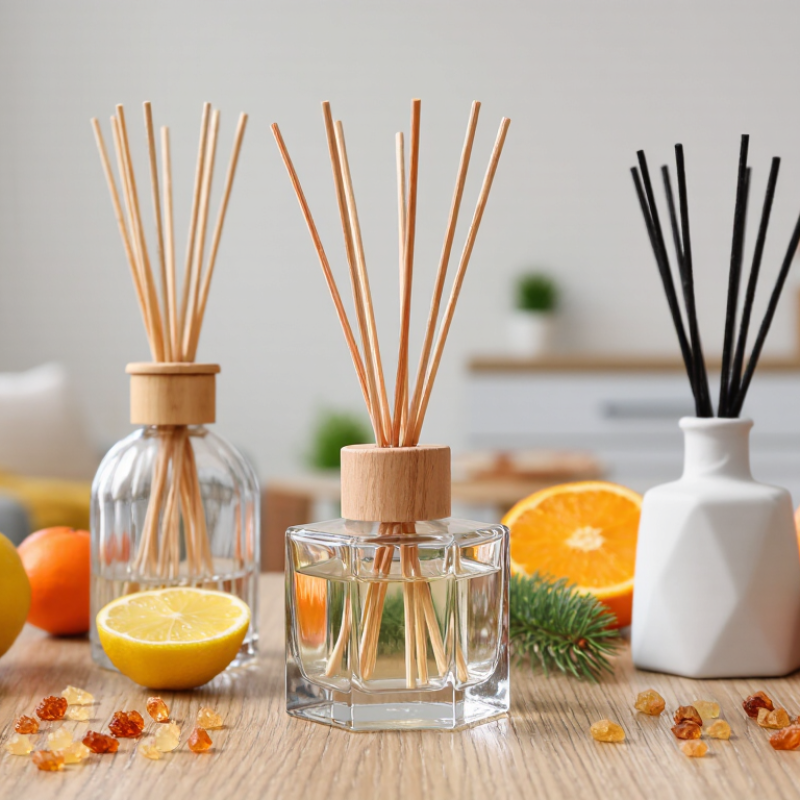
How to Choose the Best Fragrance Diffuser Stick?
A high-performing diffuser stick should deliver steady scent, not simply stronger scent. The key indicators are absorption speed, evaporation balance, and room coverage. Reed diameter and fiber structure affect how quickly fragrance travels upward. Natural rattan may offer visible texture, but engineered fiber sticks often provide more consistent diffusion. Test both in the same room.
IFRA Standards help define safe fragrance use through ingredient restrictions and exposure assessments. However, IFRA does not create one universal VOC limit for every diffuser. VOC requirements depend on the product category and local regulations. Always request the latest IFRA conformity document and Safety Data Sheet from the supplier. The U.S. Environmental Protection Agency reports that indoor pollutant levels are often two to five times higher than outdoor levels, and occasionally much higher. Ventilation matters. A stronger scent can reduce comfort.
Tips: Weigh the bottle before testing. Record its weight after 24 hours, then compare scent strength at one, three, and five meters. Check whether the liquid becomes cloudy or the sticks dry unevenly. Review current regional VOC rules, because limits can change. A practical mistake is judging performance by intensity alone. I would also test a smaller room first; large-room results can look impressive but feel weak in daily use. IFRA’s current Standards Library and EPA indoor-air guidance provide useful technical references.
| Evaluation Dimension | Recommended Screening Benchmark | What the Data Indicates | Safety or Quality Relevance | Preferred Result |
|---|---|---|---|---|
| Stick Material | Natural rattan or engineered fiber | Rattan uses longitudinal capillary channels; fiber sticks generally provide more uniform liquid transport and release. | Material structure directly affects scent consistency, startup time, and replacement frequency. | Consistent capillary flow |
| Stick Diameter | Approximately 3–5 mm for general indoor use | Smaller diameters usually moderate evaporation, while larger diameters can increase liquid uptake and fragrance output. | Diameter should be evaluated together with stick count, liquid viscosity, room temperature, and airflow. | Balanced output |
| Recommended Stick Count | 4–8 sticks for a 100 mL vessel | Adding sticks normally increases exposed surface area and fragrance release, but may shorten service life. | A controllable stick count helps users adjust intensity without changing the formulation. | Adjustable intensity |
| Liquid Viscosity at 25°C | About 2–10 mPa·s as a practical screening range | Lower-viscosity liquids generally travel more readily through the stick structure; higher viscosity may slow uptake. | Viscosity is not an IFRA limit. It is a performance variable that should be measured with a defined test method. | Stable wicking |
| Initial Fragrance Release | Noticeable scent within approximately 2–24 hours after insertion | Startup depends on stick porosity, fragrance polarity, carrier composition, temperature, and room ventilation. | A clear test protocol is required because “strong scent” is subjective and cannot be defined by IFRA alone. | Predictable startup |
| Evaporation Rate | Approximately 1–4 g/day for a 100 mL diffuser under controlled indoor screening conditions | Actual loss varies substantially with exposed surface area, temperature, humidity, ventilation, and stick configuration. | Use gravimetric testing at a defined temperature and airflow; do not treat this range as a legal requirement. | Controlled release |
| Expected Service Life | Approximately 25–60 days for 100 mL under moderate indoor conditions | Higher airflow, frequent stick turning, warm temperatures, and more sticks can reduce longevity. | Performance claims should state the test conditions instead of presenting one universal duration. | Condition-based claim |
| IFRA Documentation | Current IFRA conformity certificate for the finished fragrance and intended product use | The certificate should identify the applicable IFRA product category, maximum fragrance concentration, amendment version, and restrictions. | IFRA standards address fragrance safety restrictions; they do not certify diffuser performance and are not a substitute for local chemical regulations. | Documented conformity |
| Fragrance Concentration | Formulated below the lower of the IFRA maximum or applicable legal limit | The permitted level depends on the complete fragrance formula, restricted constituents, intended use category, and current IFRA amendment. | Do not infer compliance from fragrance oil percentage alone; obtain a product-specific certificate and safety data. | Formula-specific limit |
| VOC Assessment | Measure total volatile content and regulated substances using a jurisdiction-appropriate method | VOC definitions, exemptions, test methods, and allowable limits differ by country, region, product category, and intended claim. | There is no single worldwide VOC limit for all reed diffusers. Confirm requirements for the sale location and product classification. | Verify local limit |
| VOC Reporting Data | Keep a formulation-based VOC calculation plus laboratory data where required | Record ingredient identity, mass fraction, volatility classification, test method, detection limits, and calculation assumptions. | Transparent records support regulatory review and reduce the risk of unsupported “low-VOC” claims. | Traceable results |
| Allergen and Restricted Substance Review | Screen fragrance constituents against current regional disclosure and restriction requirements | Some fragrance constituents may require labeling or concentration control even when the overall fragrance load is low. | Review the finished mixture, not only the fragrance concentrate, and update the assessment when the formula changes. | Current compliance review |
| Flash Point and Flammability | Determine the finished liquid’s flash point and assign hazard communication according to the destination market | Carrier choice and fragrance composition can materially change flammability classification. | Use the finished product’s safety data sheet and required label statements; keep away from flames and ignition sources. | Hazard classified |
| Leakage and Stability Test | Pass upright, inverted, transport-vibration, temperature-cycle, and closure-compatibility checks | Testing should confirm that the vessel, stopper, seal, and fragrance liquid remain compatible throughout expected storage. | Prevents liquid loss, package damage, and unintended exposure during transport or normal use. | Package compatible |
| Performance Test Conditions | Report temperature, relative humidity, airflow, vessel opening, stick count, liquid mass, and test duration | Small changes in environmental conditions can produce large differences in evaporation and scent output. | Standardized conditions make comparisons meaningful and prevent misleading performance claims. | Comparable testing |