
Leave Your Message
Finding China’s Best Candle Jar Supplier for Global Buyers requires more than comparing factory prices. Buyers need dependable glass, stable decoration, safe packaging, and clear export communication. A Candle Jar may look simple, yet its performance depends on wall thickness, thermal resistance, lid fit, coating quality, and wax compatibility. Small details matter.
Industry demand supports careful supplier selection. Grand View Research reported that the global candle market reached approximately USD 12.88 billion in 2022, with projected growth from 2023 to 2030. Fortune Business Insights also forecasts continued expansion, although its market estimates differ because research methods and category definitions vary. That difference deserves attention. Market data is useful, but it should not replace factory verification.
Experienced buyers usually request samples before placing large orders. They check rim smoothness, color consistency, surface defects, burning behavior, and carton strength. A professional supplier should provide clear specifications, production photographs, inspection records, and realistic lead times. Certifications and test documents must also match the destination market. Never accept a logo without verification.
Cost alone can mislead. A cheaper jar may create higher breakage, leakage, or rejection costs after shipment. Strong suppliers explain their glass source, mold capability, quality-control process, and response plan for defective goods. They also understand private labeling, custom colors, frosted finishes, and different lid materials. However, no supplier is perfect. Communication gaps, seasonal delays, and sample-to-mass-production differences can still occur. Global buyers should document every requirement and keep approval samples for comparison. This guide examines how to identify a reliable Chinese Candle Jar supplier through evidence, practical testing, and transparent purchasing standards.
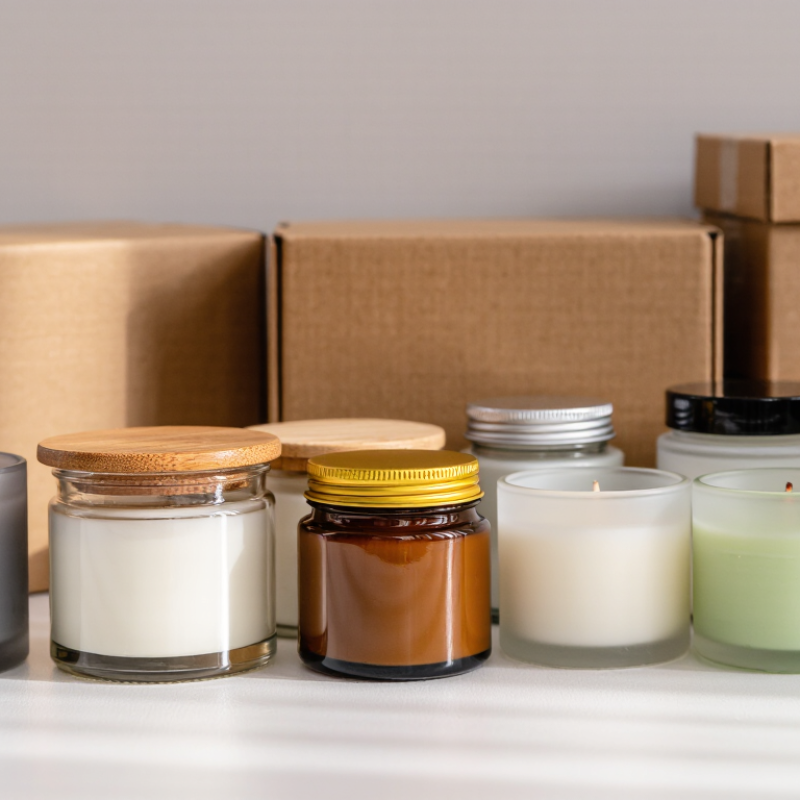
China Best Candle Jar Supplier for Global Buyers?
The global candle market reached approximately $9.9 billion in 2023, according to Grand View Research. Its report projects a 5.7% compound annual growth rate through the forecast period. This growth reflects steady demand for home fragrance, gifting, relaxation, and seasonal décor. Yet market expansion does not guarantee consistent jar quality.
Small details matter. A 2-millimeter rim defect can weaken shelf appeal. Uneven glass thickness may create heat stress during burning. Experienced buyers should request wall-thickness records, thermal-shock testing, dimensional tolerances, and batch-level inspection reports. ASTM F2417, ASTM F2058, and relevant European candle standards offer useful technical references. Requirements still vary by destination.
Future Market Insights also identifies premium presentation and scented products as important market-development factors. That trend increases pressure on jar suppliers to deliver reliable color, weight, finish, and packaging. A capable Chinese supplier should provide production samples, documented quality controls, and traceable corrective actions. Ask for burn-test evidence with the intended wax, wick, fragrance load, and lid. Generic testing is not enough. I have seen attractive samples fail after scale-up. This is easy to overlook. Supplier selection should therefore compare verified production data, not only unit price or catalog images.
| Data Dimension | Benchmark or Specification | Buyer Relevance | Reference or Qualification |
|---|---|---|---|
| Global candle market size | US$9.9 billion in 2023 | Provides a market-scale reference for candle and candle-container sourcing decisions. | Grand View Research market estimate cited in the supplied title. |
| Projected market growth | 5.7% CAGR | Indicates sustained demand growth and the need for scalable jar capacity and repeatable quality control. | Grand View Research CAGR cited in the supplied title; forecast-period definitions should be checked in the original report. |
| Primary jar material | Glass | Offers product visibility, a premium appearance, and compatibility with many container-candle formats. | Container selection must be validated through candle-burn and thermal testing for the specific wax, wick, fragrance, and fill weight. |
| Alternative jar materials | Ceramic, metal, and heat-resistant composite materials | Support different design, weight, opacity, decoration, and shipping-cost requirements. | Material suitability depends on heat resistance, dimensional stability, coating performance, and applicable market regulations. |
| Common container capacity range | Approx. 100–500 mL | Covers many small, medium, and large retail container-candle formats. | Actual wax fill weight varies by wax density, vessel geometry, headspace, and production process; capacity must not be treated as net candle weight. |
| Typical retail fill-weight examples | Approx. 100 g, 200 g, and 300 g | Useful for comparing jar sizes, label layouts, shipping cartons, and consumer price tiers. | These are common commercial size references, not universal standards. Final fill weight should be specified in grams. |
| Critical dimensional controls | Outer diameter, inner diameter, height, wall thickness, base diameter, and usable fill height | Controls wick placement, label fit, lid compatibility, carton design, and production-line handling. | Dimensions should be stated with tolerances on the approved technical drawing. |
| Thermal-performance requirement | Container must withstand the candle’s intended burn conditions without hazardous failure | Reduces the risk of cracking, breakage, excessive heat transfer, or unsafe surface temperatures. | Performance depends on the complete candle system, not the empty jar alone. Test the final wax, wick, fragrance, dye, fill weight, and lid configuration. |
| Candle fire-safety reference | ASTM F2417 | Provides a recognized U.S. reference for candle fire-safety evaluation. | ASTM F2417 is titled “Standard Specification for Fire Safety for Candles.” Confirm the current edition and applicable market requirements. |
| Candle warning-label reference | ASTM F2058 | Supports the review of cautionary labeling for candles sold in relevant markets. | ASTM F2058 covers candle fire-safety labeling. Local labeling laws and retailer requirements may also apply. |
| European fire-safety references | EN 15493 and EN 15494 | Helps buyers organize fire-safety and product-safety labeling reviews for European-market candles. | Verify the current standards and applicable legal requirements before placing products on the market. |
| Quality-control checkpoints | Visual defects, dimensions, wall thickness, weight, leakage, coating adhesion, logo placement, and packing condition | Creates measurable acceptance criteria for pre-production samples and mass production. | Inspection levels, sampling plans, and tolerances should be agreed in the purchase specification before production. |
| Packaging priorities | Individual protection, edge cushioning, divider strength, moisture control, and carton drop resistance | Helps reduce breakage and cosmetic damage during international transportation. | Packaging should be validated through shipment simulation or agreed handling tests appropriate to the product and route. |
| Sustainability considerations | Reusability, recyclable material streams, reduced packaging, and transparent material declarations | Supports buyer sustainability policies and consumer communication. | Recycling availability varies by country and local infrastructure; environmental claims should be supported and jurisdiction-specific. |
| Recommended supplier documentation | Technical drawing, material declaration, sample approval record, inspection report, packing specification, and test records | Improves traceability, repeat ordering, and dispute prevention for global buyers. | Documentation requirements should be agreed before tooling, sampling, and mass production. |